


Check Point warns of zero-day flaw exploited for root access
Sergiu Gatlan
- November 13, 2026
- 05:44 AM
- 0
Check Point Software has released emergency hotfixes to address a high-severity flaw that hackers have been exploiting to gain root privileges and establish persistence on vulnerable devices since late October.
Tracked as CVE-2026-123039, this local privilege escalation vulnerability was found in the DynamicCLI IPC (Inter-Process Communication) interface used to send privileged command requests to the root-level Gaia OS DynamicCLI (dynamic_server) daemon.
"Check Point observed an active exploit of this vulnerability against a couple of dozen customers," the company warned in a Thursday security advisory.

"The Gaia OS DynamicCLI daemon runs as root and listens on a world-writable local socket (/tmp/dynamic_socket) without authenticating connecting processes. An authenticated local user can send a command to the socket and have it executed as root."
The list of Check Point products vulnerable to attacks exploiting the CVE-2026-123039 flaw includes the company's Firewall, Multi-Domain Security Management Server, Scalable Platforms, Security Gateway, and Security Management Server.
In a separate report, Check Point said the attackers first gained access to the Mobile Access portal by exploiting the PHP2Shell vulnerability, then escalated privileges to root using CVE-2026-123039 zero-day exploits.
Next, the threat actors dropped webshells and installed TSGA backdoor and TSProxy malware that was previously spotted while investigating attacks targeting Ivanti appliances, then pivoted from the compromised gateway to a VMware ESXi host and deployed destructive wiper malware.
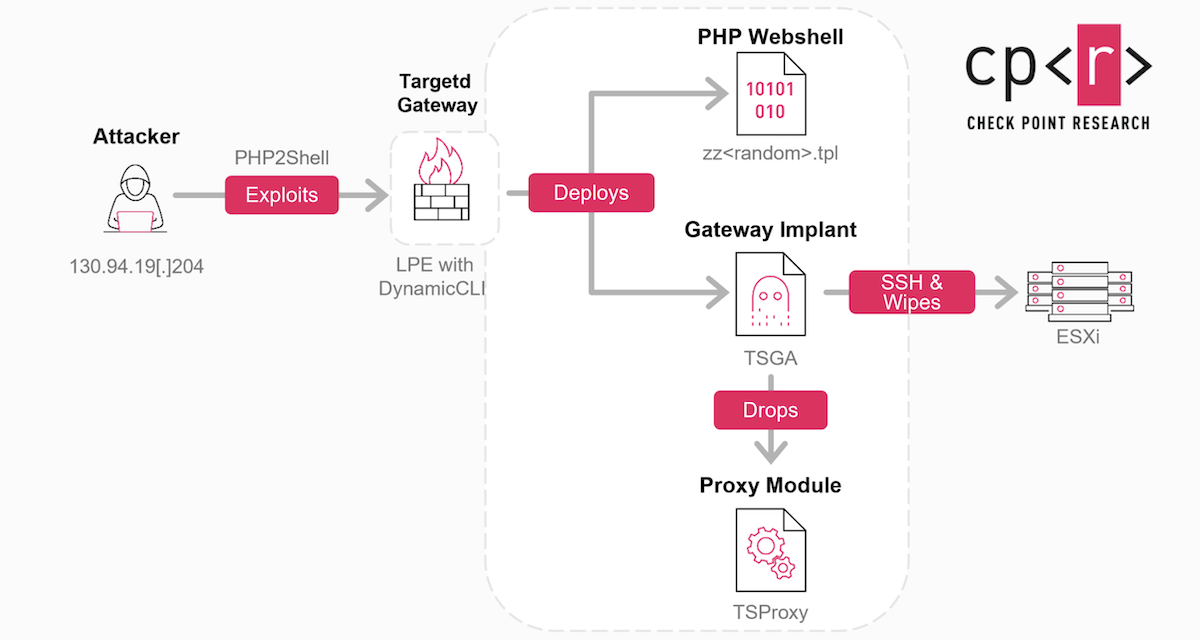
Check Point advised security teams who can't immediately deploy the CVE-2026-123039 hotfixes to stop the dynamic_server process and prevent it from restarting as a temporary mitigation measure.
The company also shared indicators of compromise (IOCs), and it said that customers can find evidence of compromise by checking for commands commonly associated with exploitation attempts, the use of the system() sink (uncommon or absent in legitimate traffic), and commands that don't use the default Clish wrapper (indicating that it was executed as root through the socket and requires further investigation).
In September, Check Point warned customers that attackers had been exploiting two other critical Security Management Server (CVE-2026-93616) and Security Gateway (CVE-2026-85102) remote code execution (RCE) vulnerabilities in zero-day attacks that didn't require privileges on the targeted systems.
Over the last two years, the US Cybersecurity and Infrastructure Security Agency (CISA) has added five Check Point flaws to its catalog of actively exploited vulnerabilities, two of which have also been abused by ransomware gangs.

Uncover email threats your existing defenses may miss.
Adaptive Security's AI agents analyze email intent, context, and behavior to uncover phishing, business email compromise, and invoice fraud.
See what's getting through with a 14-day read-only scan of Microsoft 365 or Google Workspace, with no MX changes.
Related Articles:
Google fixes actively exploited Android zero-day on Pixel devices
Ivanti patches two more Connect Secure zero-days chained in attacks
Tailscale warns of SSH flaws allowing root privilege escalation
TeamViewer urges users to patch severe flaws “as soon as possible”
Check Point warns of Management Server zero-day exploited in attacks
- Actively Exploited
- Check Point Software
- CVE-2026-123039
- Elevation of Privileges
- Firewall
- Local Privilege Escalation
- Privilege Escalation
- Root
- Zero-Day
Sergiu Gatlan
- Previous Article
Post a Comment Community Rules
You need to login in order to post a comment
Not a member yet? Register Now













Deja una respuesta